Timeless Tweets

Fri Oct 30 12:54:32 2009 EDT (-0400 GMT)
Timeless Tweet

Allow me to promote my latest web/twitter project: timelesstweet.com or @timelesstweet . If you’ve used twitter, or even if you haven’t, you may be familiar with the “Did you hear? A celebrity died. RIP celebrity.” theme or “Can’t wait for the weekend!” them found in a lot of people are saying there. This is what inspired me to create timelesstweet.com – a collection of generic thoughts like this that always seem applicable.

If you’re on twitter follow @timelesstweet, and if you’re not, visiting timelesstweet.com might give you some more reasons not to.

Twitter in your inbox

Fri Oct 23 15:39:38 2009 EDT (-0400 GMT)

Here’s how you can add your “at messages” to your Mac Mail.app 10.5 or 10.6 (or Thunderbird or Outlook Pro, etc.) via Twitter search’s RSS feed.

I’ve become a twitter re-tweet junkie. To get my fix I added an RSS feed of twitter’s search results to Mail.app. Here’s how I do that:

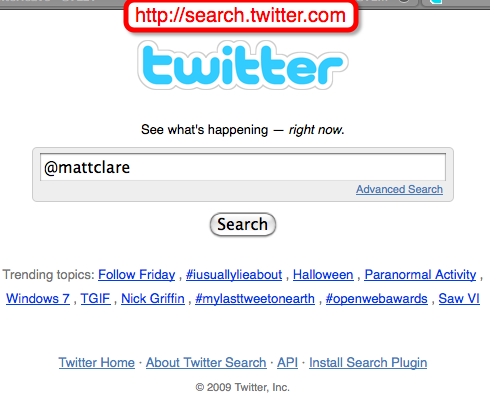
  1. search.twitter.comGo to http://search.twitter.com and search for @your_twitter_handle (ie. @mattclare)
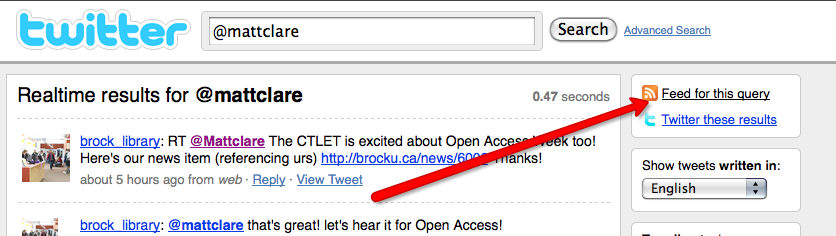
  2. Grad the RSS feed URL found on the right of the results page.Twitter search results RSS feed
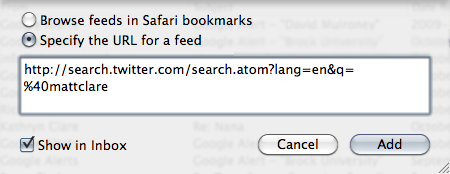
  3. In Mail.app’s bottom right (or in Thunderbirds’ or Outlook’s account preferences) add a new RSS feed. Add RSS Feeds
  4. Add RSS feed dialogePaste in the RSS URL. You may want to also check to have it appear in your RSS feed. and press “Add”.

That should be it! Now whenever your account gets re-tweeted, “replied to” or otherwise mentioned you should see it in your inbox. Sure our inboxs are all already too full, but at least these messages will be short.

Snow Leopard Tops

Wed Sep 30 11:08:40 2009 EDT (-0400 GMT)

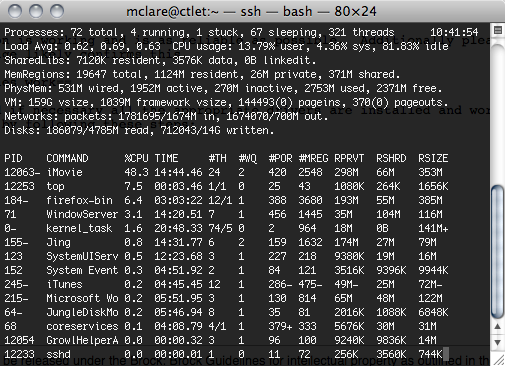
Apparently in the new version of Mac OS X, Snow Leopard, there is an update to the command line tool ‘top’. Now it not only displays CPU, memory and disk I/O information it also has network I/O. There might be hundreds of new features! My count so far 1 * 3 (exchange support) and this….

New Top

British Government Issues Apology to Alan Turing

Tue Sep 22 9:59:55 2009 EDT (-0400 GMT)

I feel badly that I missed this, but I was so busy at the time.

John Graham-Cumming’s petition to have the British Government apologies for the homophobia that lead to the conviction of Alan Turing for the “Mental Illness” of homosexuality was successful!

Alan Touring worked during the Second World War for the British Government Code and Cypher School at Bletchley Park. His work helped crack the German Enigma code, an advantage that made a huge impact on allied strategy and ultimate success.

As a professor at the University of Manchester and Cambridge he was influential in the development of computer science and developing the concept of the algorithm and computation with the Turing machine. His Turing test was the original benchmark for determining artificial intelligence.

The Turing test is basically a test where a human judge engages in a natural language conversation with one human and one machine, each of which tries to appear human. If the judge can’t tell the machine from the human, the machine is said to have passed the test. The T in CAPTCHA (those squiggles on websites to confirm if you are human or not) stands for the Turing test: Completely Automated Public Turing test to tell Computers and Humans Apart.

Lastly the Turing programming language, developed in 1982 at the U of T, was the first programming language I was taught…… well it was only named after Turing, so we can’t hold that against him.

In 1952 Turing was convicted of the crime of homosexuality. Instead of two years of prison or hard labour he accepted the alternative punishment of being injected with female hormones. The percussion and mental and physical effects of the female hormones (and I’m sure much more) drove him to commit suicide in 1954 by eating cyanide poisoned apple.

On September 10th, Gordon Brown apologized, saying “…on behalf of the British government, and all those who live freely thanks to Alan’s work I am very proud to say: we’re sorry, you deserved so much better.”

No one deserve to be treated the way he was, least of all a war here. More can be found on the BBC’s web site.

Instructor blogs in post-secondary

Mon Sep 21 10:04:50 2009 EDT (-0400 GMT)

At work a recently was E-Mail by a college at Brock University how was starting some research in to faculty blogs. She was interested in information or links I may have about faculty blogs at Brock University. I shared what I know about and but preference all that information with “I have my own feeling about faculty blogging/course blogging and learner focused teaching, but that aside.”

That lead to as to what those feelings might be. I was surprised to learn that I had a lot, and after banging out a few paragraphs in response I asked if I could share those thoughts in my own blog (it’s a busy time of year, and I want every keystroke working as hard as it can for me). So with that, here are my thoughts on faculty blogging/course blogging:

I don’t have a strong feeling, if I did it would impede my work, but that hasn’t stopped me from having a lot to say.

I do feel that something like an LMS (which I support at Brock University – so that’s my bias) which has an announcements tool for broadcasting messages to everyone, as messages tool for peer-to-peer private messages or cc’ everyone messages, and a forum/discussion board better servers the purposes of what most course blogs are used for. With the notable exception of a visually appealing appearance and having a strong public face. I also want to highlight that this is in the context of a class, which is a defined group of limited
size. When you don’t know who your audience is, or when they’ll be interested and where they’re from, a blog is great.

One reason I like having a blog is it keeps others updated on my goings on and contains a small spot for comments from readers. Anyone that wants to read it can, or choose not to.

In a course context I feel like a class blog strongly privileges the instructor over the learners. The instructor is the only one who can create a post and the responses of students are limited to the comments area. This precludes the students from introducing a topic, structurally, they can only respond to those of the instructor – and even then the comment would have to be “public internet” worthy. In that way I feel it creates a technical structure that replicates or re-invents the sage-on-the-stage format of a giant 500 seat lecture hall.

I think that the structural disparity in roles is what makes a blog worse as a teaching tool than just a simple web page with content. A two-way dialogue appears unwelcome compared to a discussion forum
which arranges information in a more egalitarian way.

Blogs also aren’t that great about notifying readers of new content that is important. At any moment important content could be posted, so students must keep checking the site, it’s like a captive audience
which again I think privileges the instructor over the student.

Outside of the structural issues, there’s the nature of blogs issue. I think a blog can be more about vanity than teaching, that and I’d hate for anyone to feel like they had to read all of my blog postings or fail.

To that end, I don’t see class blogs as great tool for course management issues nor do I see it being great tool for dialogue.

That said in k-12, it’s a great way to keep parents in the loop. Also I’ve always felt that the more the university sector can do on the public internet the better. That’s why I’m an advocate of wikis, etc – and a blog is certainly better than no asynchronous electronic information at all!

I was profiled in St. Catharines Standard, Feb 3 2006, issue in an article about me as a blogger titled “15 bytes of fame” — I mistakenly fed the journalist that line and she warned my it might become the title — but that doesn’t make me an expert. If instructors ask me where to setup a blog for their course I point them
to blogger.com or wordpress.com and move on.

That’s my take on it and probably Michel Foucault and Karl Marx’s or something. Thanks for asking, I apparently had a lot to share.

Those were my comments. I’d clarify, now that it’s in a public forum, that the nature of a blog can be less about vanity and more about teaching, but that would require a strong mental-editor inside that instructor/blogger. That’s enough back-peddling for now, I’ll save the rest for if I get a lot of comments.