Lindz and I bought a Christmas tree on Sunday and put it up in our cheap plastic tree stand that day. This is the first year we’ve put the tree up on our main floor with 9′ ceilings, so we went with a 8′ tree.
Monday night we decorated it and went to bed.
At about quarter to four in the morning we were woken by the crash of a tree and christmas bulbs rolling across our hardwood. Lindz and I both got up with a start and as Lindz turned on the lights while I charged for the tree and started lifting as soon as had a hand on it and place it in the corner of the room. I know from an incident with a cat, a fish and fishbowl in my parent’s kitchen what large amounts of water can do to hard wood.
The good news was that our area rug absorbed all the water and didn’t let it through to the wood. We propped the rug up on a chair and placed a fan in front of it. Lindz place the tree skirt in the tub and at about 4:15 we went back to bed. Lindz got some sleep, but I didn’t.
Later that day I went to Canadian Tire to buy a new tree stand. After standing there looking at tree stands for a few minutes I said to the guy about my age who was standing there as long as me “… well I think I’m going with this one.” As I walked away he enquired why and I told him about my earlier morning and he said the same thing happened to him and asked if “…I had that cheap plastic thing”
“Yeah, with the small metal screws.”
“yeah!”
He decided to wait, but I guess his tree wasn’t stuck in a corner threatening to get sap on the walls.
Tonight we finally put the decorations back on and it looks better than ever, but my Christmas spirit has yet to recover.
Posted in Pictures|Comments Off on Cheap plastic tree stand
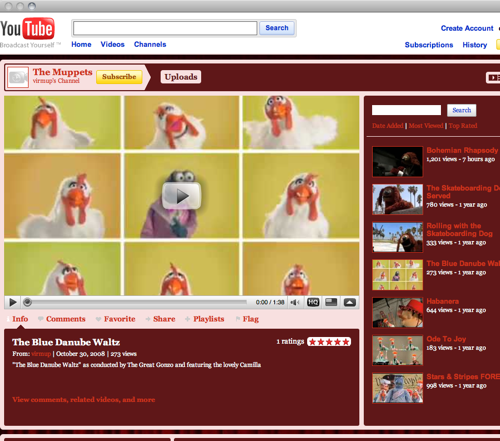
When I was a kid I considered the position of Statler or Waldorf as a real career option. They are rumoured to be based on Jim Henson’s college professors. Now that I think about it, the only thing holding me back now is that I need a partner and a balcony.
Posted in review|Comments Off on Muppets on YouTube!
What follows I had actually hoped to present on this at the last Sakai Conference. Brock University is not a member of the Sakai Foundation, but had intended to become one, as such the ambiguity made it hard to register.
Brock University offers only a few on-line or distance courses and as such Brock’s LMS functions primarily as an additional channel of communication; content distribution; and community for otherwise face-to-face courses based at one of the two physical campuses. This amounts to slightly more than a thousand courses with faculty responsible for their own course spaces with complete control over it. The responsibility for assisting instructors in their development of on-line course content falls upon myself and the other important members of the Centre for Teaching, Learning and Educational Technologies (CTLET) at Brock University.
The CTLET strives to offer a high level of support through: one-on-one consultations, workshops, E-Mail dialogues and phone-based support, but one thing is certain; every instructor cannot expect that when they need help with Sakai/Isaak that they can pickup the phone and get someone immediately. If the answer to every question about Sakai/Isaak could only be found at the other end of a telephone the ability to distribute critical information would be severely limited and it would represent a considerable bottleneck.
Personal one-on-one help is important and very effective, but it is also resource intensive to deliver. University technical and pedagogical support staff work conventional business hours, however, instructors need not work from their office nor work conventional business hours. These are schedules and locations that do not always compliment each other.
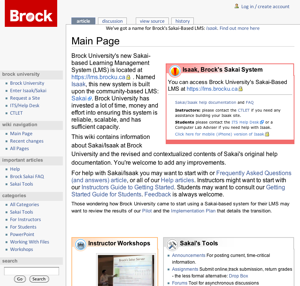
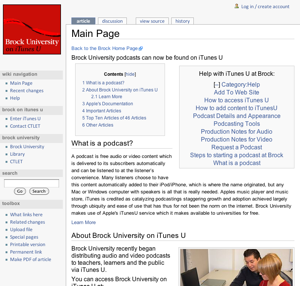
The web is the best tool for infinite access to the same resource and to that end the CTLET look to Wikis to document things like WebCT, Sakai/Isaak, Brock University on iTunes U, etc. This decision to use a wiki was because of the constantly evolving nature of these teaching tools and the scarce resources of the Centre: It was just more timely to write-up articles that explain things or to write a how-tos that were sufficient and then post them. We could then come back latter and improve the articles. It also ensured that everyone could contribute to the documentation; including users, other support professionals on campus and occasionally students.
The software selected to power the wiki was MediaWiki, as it is a well known software that powers Wikipedia. The slightly cryptic syntax for creating articles is hopefully more accessible because of its use in Wikipedia.
The CTLET’s staff are by far the most frequent contributors, and my understanding is that wikis have a motivated core that maintain the site and contribute the most while the vast majority of readers do not turn into contributors. When it does occur the help of others is appreciated. As the original author of an article being able to edit the article quickly in someone else’s office with the edge case of Windows 2000 and Office 2002…. etc, is very helpful.
With these open-source licenses in mind I wrote a script scrape the basic Sakai help information and format it into a MediaWiki export file which was imported into the Wiki and formed the basis of a number of articles. The source of that script is presently located at http://mattclare.ca/wordpress/wp-content/uploads/2009/11/help_scrape.phps_.html .
How You Can Use A Wiki
If you are interested in starting your own MediaWiki based Sakai documentation this script will generate a version of the 2.6.1 help information in a format that can be imported into any MediaWiki wiki. All are welcome to make use of it, but please be warned that I have never been taught anything about writing a parser and this script was to be a one-off.
Another option would be to export certain categories from our current Sakai/Isaak wiki, which could possibly give you too much information, especially too much Brock University information. But if you’re interested you can export whole categories by name at http://kumu.brocku.ca/sakai/Special:Export.
In both cases the user who is going to import the file into MediaWiki needs to be a MediaWiki SysOp.
Anyone is welcome to copy and paste Brock University Sakai/Isaak documentation into their own, provided that they respect the original licence under which it was published.
I asked the same of Rutgers and the University of Indiana and both responded that it’s posted under a creative commons licence for that purpose.
This article is based on the equivalent Isaak, Brock University’s
Sakai-Based LMS, help article found at: http://kumu.brocku.ca/sakai.
All respective sources used are under a free-for-reuse license and
additional permission has been obtained.
If you would like to replace Sakai’s own help files with your institution’s MediaWiki articled here are the two additions that
are required to the respective configuration files to make the Sakai help buttons point towards the wiki:
sakai.properties (Sakai’s settings file)
#Redirect Help to Wiki site

help.redirect.external.webapp=https://kumu.brocku.ca/sakai/Help
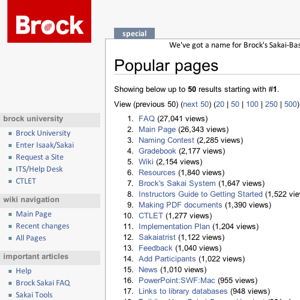
The experience of the Sakai/Isaak Wiki and the WebCT Wiki before that has been very positive. The CTLET’s staff added most of the content, but some has been amended and revised by other staff members and stakeholders at Brock. Most importantly, those who are trying to make use of the documentation have also contributed. Some edits have been substantive, while others have been made to correct errors or typos such as “hte†in the place of “theâ€Â. The most viewed article in the wiki is the FAQ which has been viewed over 27 thousand times. The FAQ, or Frequently Asked Questions, article has gone through a number of revisions to refine answers and add or remove questions to ensure it is always current.
I have actually presented on the WebCT Wiki and podcasting at Brock University in my presentation “Teaching Support 2.0â€Â, given at OUCC/CANHEIT 2006, May 28 – 30, 2006 at Guelph University and Canadian WebCT E-Learning Conference, June 19 – 27, 2006 at the University of Alberta. I apologized then for the title then and I’ll apologize for it again here.
A measure of the wiki’s success might be its most popular pages or the most linked-to categories or most linked-to pages.
I hope you will consider a wiki for documentation projects and tool as we have at the CTLET at Brock University. Wiki articles benefit from constant revision and the experience of users making articles very timely. Anyone who is motivated can update the resource and everyone benefits from the small contributions of users in the larger repository. This is in contrast to previous methods of offering text-based support: rapidly ageing and easy to lose manuals, flyers and guides. Though most of the content of the Sakai/Isaak wiki is still created by the CTLET the ability for each article to be edited by anyone from anywhere provides considerable. Using the Wiki medium information can be added and re-shaped and added to again to create an organic, living document that involves the learner in their learning.
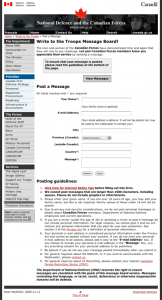
Today or any time that it cross your mind you should consider sending a message to our Canadian Forces members to let them know that you appreciate their service.
Regardless of your feelings about any one mission of the Canadian Forces you have to respect someone who at some point volunteered to risk their own life in the hope that it might protect the lives of others.
Posted in General|Comments Off on Write to our troops
Matt Clare is a Canadian Technologist who is focused on building, deploying and refining the best tools possible for teachers and learners in higher education. Advocate of making all web content accessible by making the creation process easy.


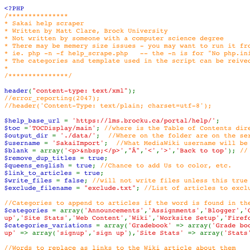 With these open-source licenses in mind I wrote a script scrape the basic Sakai help information and format it into a MediaWiki export file which was imported into the Wiki and formed the basis of a number of articles. The source of that script is presently located at